
2025 Korea Visa Guide: All-in-One Overview for Tourists, Students, Workers & Families
This Korea visa 2025 guide is designed to help you understand Korea’s short-term, long-term and permanent stay visa categories in a simple and friendly way.
✈️ 1. Big Picture: How Korea Classifies Foreign Residents
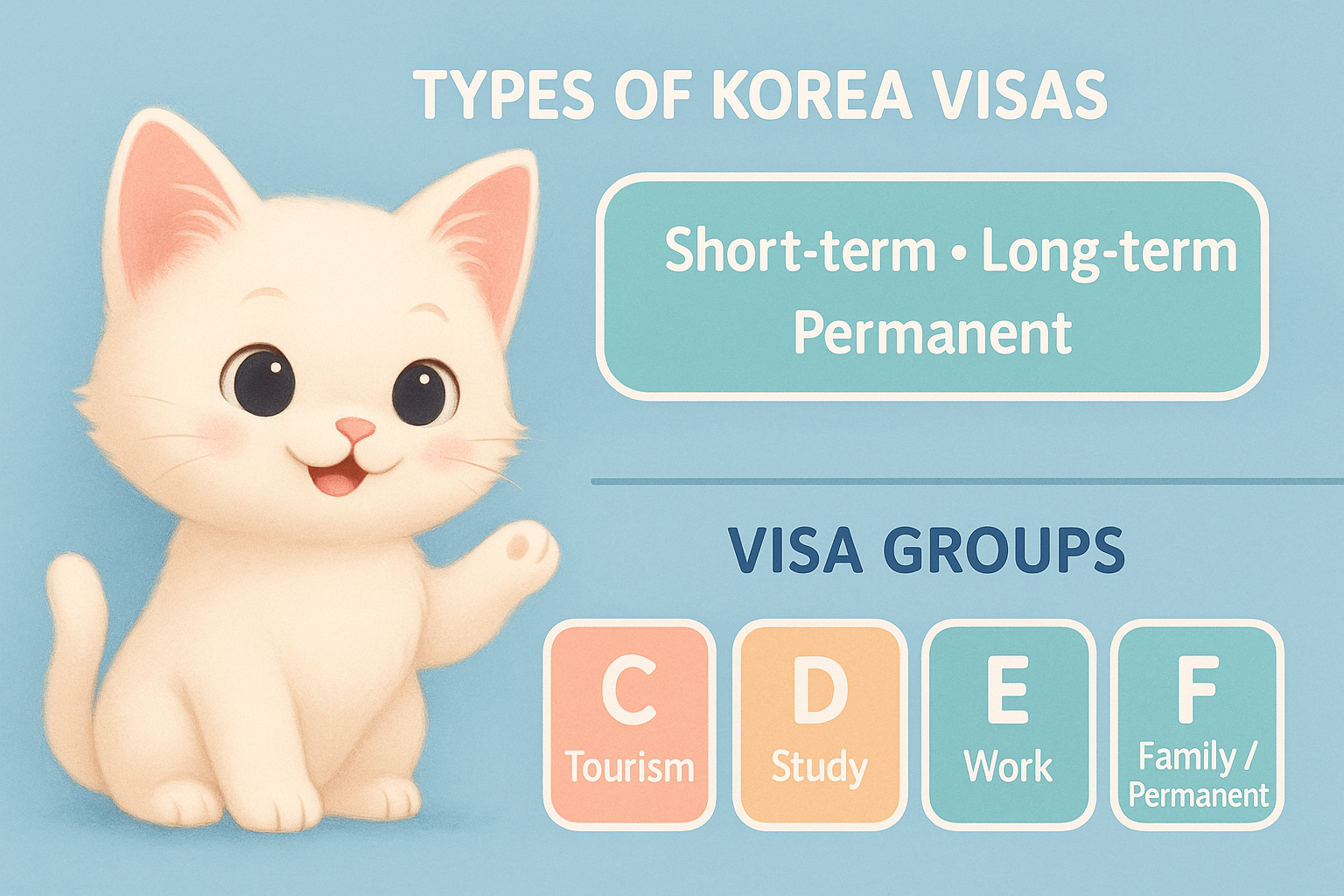
Korea categorizes foreign stays into three broad layers:
- Short-term stay — Around 90 days or less
- Long-term stay — Over 90 days (study, work, family, etc.)
- Permanent stay — F-5 permanent residence
Korea also uses two entry tools:
- Visa — For long-term or purpose-based entry
- K-ETA — Electronic travel authorization for eligible nationalities
🧾 2. K-ETA vs Visa — What’s the Difference?
2.1 What is K-ETA?
- Online authorization for visa-free nationals
- Used for tourism, family visits, short business trips
- Valid for multiple entries (varies by nationality)
2.2 When do you need a visa?
- Your nationality is not K-ETA eligible
- You want to stay longer than 90 days
- Your purpose is study, work, or joining family
📂 3. Korea Visa 2025 : Four Main Visa Groups to Understand
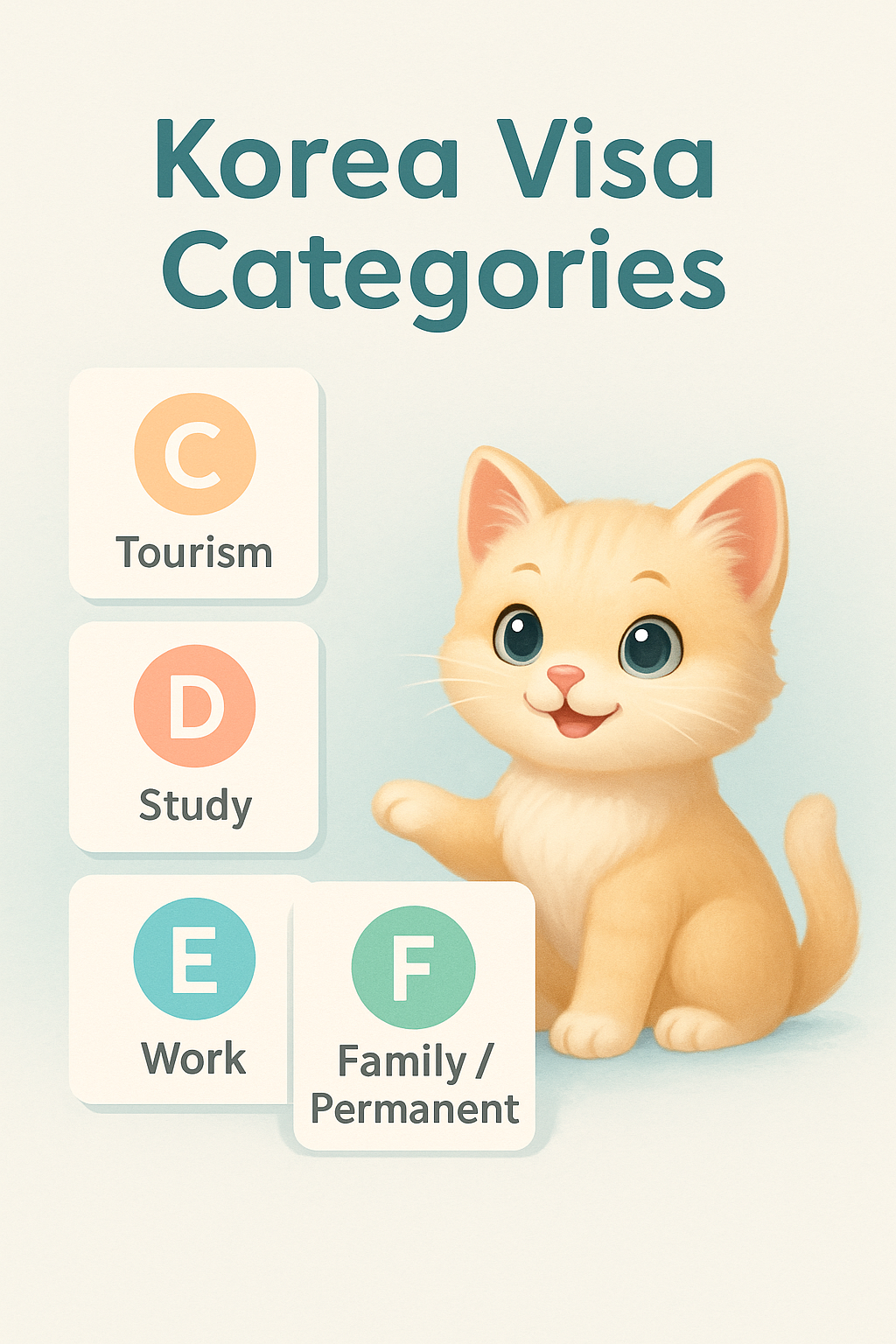
If you are looking for a clear Korea visa 2025 update, this section explains how K-ETA and C, D, E, F visas are grouped and used.
- Short-term / Tourism — C-3, K-ETA, H-1
- Study / Training — D-2, D-4
- Work / Employment — E-series
- Family / Long-term / PR — F-series
| Group | Codes | Purpose | Stay Type |
|---|---|---|---|
| Short-term / Tourism | C-3, K-ETA, H-1 | Visit, travel, short work experience | Up to ~90 days |
| Study / Training | D-2, D-4 | University or language study | Long-term |
| Work / Employment | E-1 to E-9 | Teaching, research, skilled jobs | Long-term |
| Family / Long-term / PR | F-1, F-2, F-4, F-5, F-6 | Family, residence, permanent stay | Long-term / Permanent |
🌏 4. Short-Term Options: C-3, K-ETA, H-1
4.1 C-3 Visa
- Usually up to 90 days
- Tourism, family visits, short business trips
4.2 K-ETA Entry
- No visa needed if eligible
- Apply online before travel
- Not for long-term stays
4.3 H-1 Working Holiday
- For youth (18–30) from agreement countries
- Part-time work + travel for about 1 year
- Great for “try Korea life” experience
🎓 5. Study & Language: D-2 and D-4
5.1 D-2 University Programs
- Undergraduate, graduate, college degrees
- Admission letter + financial proof required
- Extendable as long as studies continue
- Can lead to E-series jobs or F-series residence
5.2 D-4 Language Training
- Language institutes and university language centers
- Minimum weekly class hours required
- Part-time work allowed only under legal limits
💼 6. Working in Korea: E-Series Visas
- E-1 — University professor
- E-2 — Language instructor
- E-3~E-6 — Research, tech, pro jobs, entertainment
- E-7 — Skilled designated fields
- E-9 — Manufacturing & similar industries
🏠 7. Family, Long-Term Stay & PR: F-Series Visas
- F-1 — Family visit/live
- F-2 — Long-term residence
- F-4 — Overseas Koreans
- F-5 — Permanent residence
- F-6 — Marriage migrant
🪪 8. Simple Visa Application Flow
STEP 1 — Choose your visa type
STEP 2 — Prepare documents
STEP 3 — Apply at embassy or online portal
STEP 4 — Wait for review
STEP 5 — Receive visa & travel to Korea
🏢 9. After Arrival: ARC & Address Change
9.1 ARC (Alien Registration Card)
- Required for stays over 90 days
- Apply at immigration office
- Needed for banking, phone plans, housing
9.2 Address Change
- Must report when moving
- Keeps official records updated
❓ 10. Common Questions
Q1. Can I change my visa inside Korea?
Sometimes yes, sometimes no. Certain changes require leaving the country.
Q2. How do I extend my visa?
Apply before expiry with documents showing you still meet the requirements.
Q3. How do I get permanent residence (F-5)?
Usually: Several years on D/E/F visas → meet income & integration rules → apply for F-5.
📅 11. Why “2025” Matters
Visa policies evolve. New tracks appear, requirements change. Always confirm on official sites.
✅ 12. Quick Recap
Ask yourself one question:
Tourism / Study / Work / Family or Long-term Stay.
This guide introduced the big picture. Next parts will go deeper into D visas, E visas, and F visas individually.
For the official instructions, visit the Korea Immigration Service: visa.go.kr
This Korea visa 2025 overview gives you the big picture before exploring each visa type in detail.