Series: CPI & Bitcoin — Beginner Entry (B3)
This article is part of the CPI & Bitcoin series, where I try to understand how inflation data actually fits into Bitcoin’s price behavior—without predictions or trading advice.
Does High Inflation Always Crash Bitcoin?
Every time CPI data is released, I notice a familiar pattern.
Inflation comes in high, and the immediate assumption follows: Bitcoin should fall.
I used to accept that idea without much resistance.
High inflation leads to tighter monetary policy. Tighter policy pressures risk assets. Bitcoin often trades like a risk asset—so the conclusion feels natural.
But after watching several CPI releases over time, I started questioning that certainty.
Does rising inflation really lead to the same outcome every time?
That question is what I want to unpack here—slowly, and without forcing the market into a single rule.
Why inflation is commonly seen as bad news for Bitcoin
Inflation is usually framed as a problem for financial markets.
When prices rise too quickly, central banks tend to respond by tightening policy, which reduces liquidity across the system.
From that perspective, it makes sense that Bitcoin reacts negatively.
During uncertain periods, it often moves alongside equities rather than acting as a separate hedge.
That logic itself isn’t wrong.
What becomes problematic is when it turns into a fixed rule—when inflation is treated as a guaranteed trigger rather than one factor among many.
Inflation data is not the same as market expectations
One thing that became clearer to me over time is that markets don’t respond to numbers in isolation.
They respond to how those numbers compare to what was already expected.
The same CPI reading can lead to very different outcomes depending on whether it surprises the market or confirms what was already priced in.
Sometimes inflation remains elevated, yet the market reaction feels muted.
In those moments, it becomes clear that the headline number matters less than the shift—or lack of shift—in expectations.
What the market reacts to goes beyond inflation itself
CPI data doesn’t exist in a vacuum.
It’s filtered through policy expectations, liquidity conditions, and broader macro narratives.
Markets tend to focus on what comes next rather than what has already happened.
Inflation matters mainly through how it influences future decisions, not simply because it is high.
This helps explain why similar inflation environments can produce very different price movements.
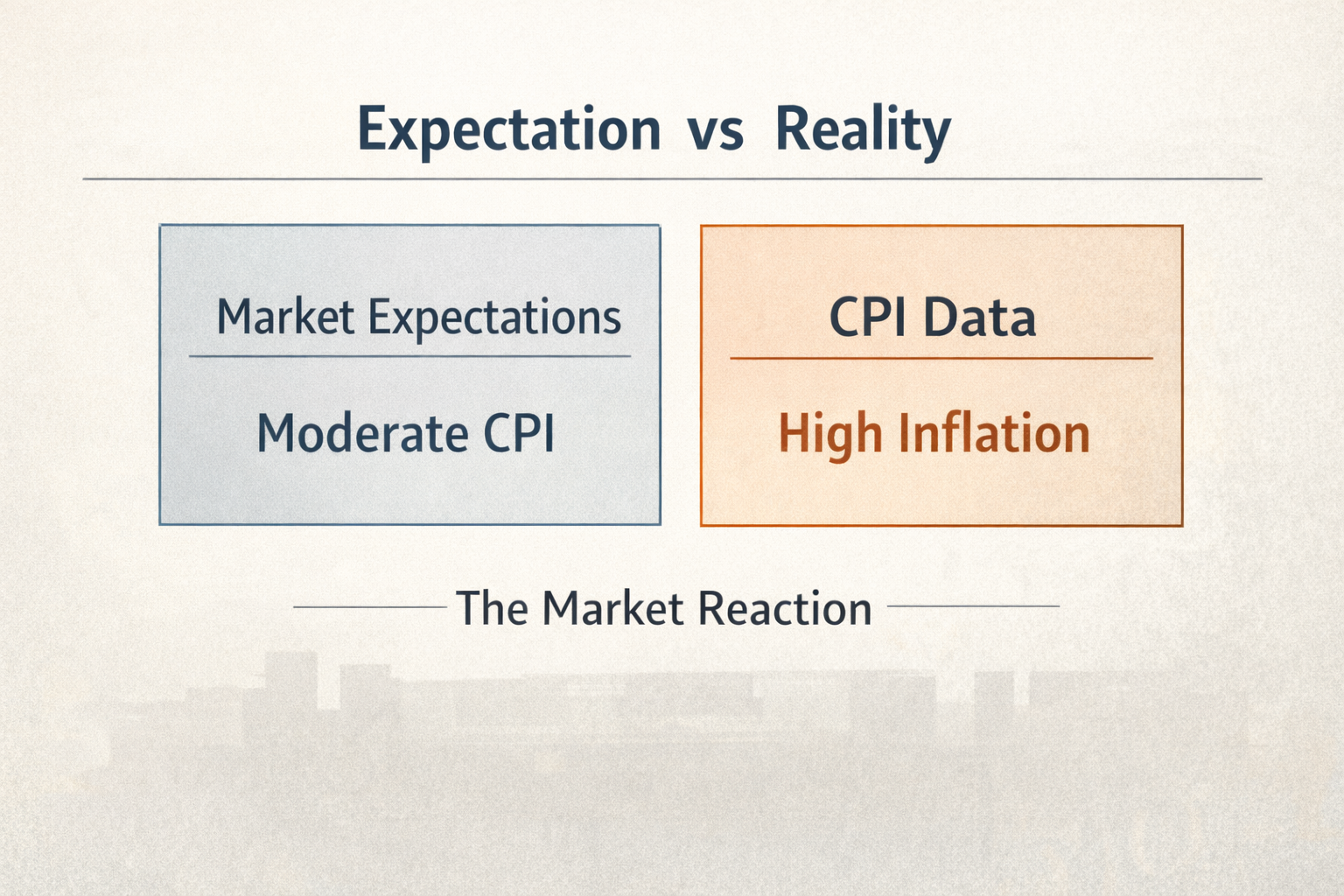
Once I started separating the number from the expectation, CPI days began to look less “automatic” and more contextual.
When Bitcoin didn’t fall despite high inflation
Looking back, there were periods when inflation stayed elevated—often above 5%—without triggering an immediate Bitcoin sell-off.
In some cases, prices moved sideways. In others, short-term rebounds followed.
Even in more recent market conditions, I’ve noticed similar patterns.
Inflation remained high, yet Bitcoin’s reaction appeared restrained, as if the data had already been absorbed.
What stood out to me wasn’t that inflation didn’t matter—but that it didn’t act alone.
Personal observation
Watching these moments helped me realize how misleading it can be to rely on a single macro indicator when interpreting market behavior.
Why this misunderstanding matters for small DCA investors
As someone who invests through small, regular purchases, this confusion can be exhausting.
Each CPI release brings the same internal debate: should something change?
Once I stopped treating inflation as an automatic signal, those moments became easier to process.
I still pay attention to the data, but I no longer assume it dictates a fixed outcome.
Here are the few things I try to keep in mind on CPI days:
- Inflation is important, but it’s rarely the only driver.
- The surprise vs. expectation gap often matters more than the headline.
- Context changes—policy stance, liquidity, and narrative can dominate.
- My DCA plan works best when I don’t force a single rule onto every move.

That shift—from certainty to context—has made market days feel a little less overwhelming for me.
So, does high inflation always mean Bitcoin must fall?
Inflation is an important part of the macro environment.
But the idea that it always produces the same result doesn’t hold up well under closer observation.
There have been repeated moments when high inflation did not lead to immediate declines in Bitcoin prices.
The difference often came down to expectations, context, and interpretation rather than the data itself.
Next in the series
In the next article, I want to look at an even more confusing situation: why Bitcoin sometimes rises after CPI data that initially looks negative.
👉 If you want to continue this series, read the next piece and compare how “bad CPI” can still lead to unexpected price action.